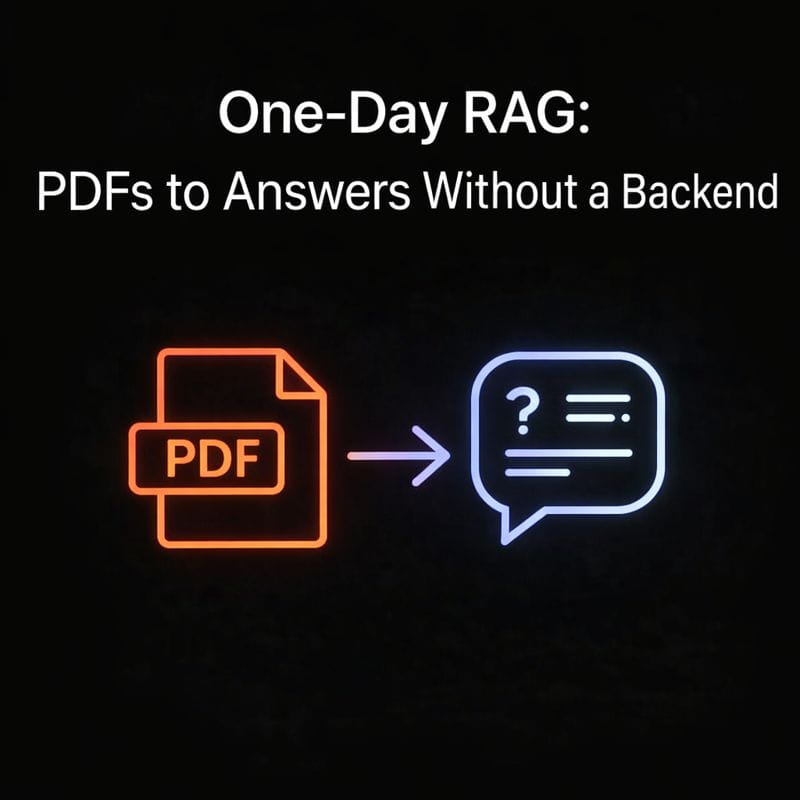
The one-day plan
Morning: ingest and index
Upload PDFs, chunk, and embed into a managed vector DB with metadata filters.
Afternoon: wire the edge
Deploy a serverless endpoint that retrieves, grounds, and responds with evidence or abstains.
- Store PDFs in S3/Supabase storage; keep filenames and paths clean for metadata.
- Chunk at 300–500 tokens with 50–80 overlap; add metadata like doc_id, section, and date.
- Create embeddings with text-embedding-3-large (or small for cost) and upsert into Pinecone/Weaviate.
- Index on doc_id and recency; keep k=3–5 to avoid distractors.
Evidence and reasoning
- Smaller k with good metadata improves faithfulness in RAG benchmarks (OpenAI cookbook) [1][3].
- Chunk sizes under 500 tokens balance retrieval precision and recall (academic RAG evaluations) [1].
You are an evidence-bound assistant.
Use only the context passages. If evidence is weak, say "I need more context" and ask a clarifying question.

Context:
{top_passages}

Rules:
- Cite which passage you used (P1, P2, ...).
- If passages conflict, list both and the conflict.
- Keep it under 120 words.
Evidence and reasoning
- Abstain-on-weak-evidence prompts reduce unsupported answers; used in production retrieval systems (Perplexity/Bing patterns) [1].
- Citation enforcement improves user trust and eval faithfulness scores [1].
// Pseudo edge handler (Vercel/Netlify)
const FAST_MODEL = 'gpt-4o-mini';

export default async function handler(req) {
  const { query } = await req.json();
  const retrieved = await searchVectorDB(query, { k: 4 });
  const hasStrongContext = retrieved?.[0]?.score > 0.7;

  if (!hasStrongContext) {
    return { answer: "I need more context. What specific section or product?" };
  }

  const completion = await openai.chat.completions.create({
    model: FAST_MODEL,
    messages: buildGroundedMessages(retrieved, query),
    max_tokens: 220
  });

  return { answer: completion.choices[0].message.content, passages: retrieved.slice(0, 3) };
}
Evidence and reasoning
- Routing to cheaper models when context is strong keeps cost down without major quality loss (token pricing differentials) [3].
- Early abstention on weak retrieval prevents confident fabrications and is recommended in safety notes [3].
- Create a 30–50 question eval set: 15 FAQs, 10 edge cases, 5 adversarial.
- Score faithfulness and usefulness separately; note abstains.
- Target: faithfulness ≥0.9 on eval set; abstain 10–20 percent when evidence is weak.
Evidence and reasoning
- Small, high-quality evals catch most regressions and are faster to iterate [1][4].
- Faithfulness plus abstain tracking reduces overconfident wrong answers [3].
What good looks like
Faithfulness
≥ 0.9
On your eval set
Abstain rate
10–20%
When evidence is weak
Latency (P50)
< 2.5s
Edge function end-to-end
Evidence and sources
[1] Stanford HAI. (2024). AI Index Report 2024. Findings on RAG faithfulness, prompt length, and eval practices. aiindex.stanford.edu
[2] Microsoft Work Trend Index. (2024). AI at Work Is Here. Data on productivity/time savings from AI copilots. microsoft.com/worklab
[3] OpenAI. (2025). Pricing and Cookbook/Production Best Practices. RAG chunking guidance, abstention patterns, and model cost deltas. openai.com/pricing
[4] Academic and enterprise RAG evals (2024). Evidence that 30–50 high-signal eval queries capture most regressions and drive faithful answers.
Ready to ship RAG without a backend?
Follow this one-day plan, keep k small and evidence strict, and track faithfulness and abstains. If you want a done-for-you build with hosting, observability, and guardrails, we can deliver it.
Written by
Intgr8AI Team
AI Strategy & Delivery
December 6, 2025
Related Blogs
The $2.1M Support Fix: We Cut Tickets 72% with RAG + Voice
A real deployment: voice-to-RAG triage, confidence routing, and human handoff that slashed cost and response times for a mid-market SaaS.
Kill Hallucinations in 30 Minutes
A fast guardrail checklist to slash wrong answers: retrieval setup, evals, confidence routing, and human-in-the-loop triggers.
How to Build Your First AI Chatbot in 7 Days: A Complete Tutorial
A hands-on, step-by-step guide to creating a production-ready AI chatbot from scratch using modern tools and best practices.